
Cloud-native, scalable imputation from Broad Clinical Labs
The All of Us + AnVIL Imputation Service helps researchers turn lower-cost genotype array data into richer datasets by filling in missing genetic information using one of the largest and most ancestrally diverse reference panels currently available.
Designed for population genomics and translational research workflows, the service combines large-scale genomic reference data, secure cloud-native infrastructure, and integrated QC, phasing, and imputation workflows. Researchers can leverage these tools without requiring an All of Us registration, and without the need to manage local infrastructure, maintain complex pipelines, or assemble reference panels.
Automated upfront quality control mitigates common execution errors, such as malformed inputs or reference mismatches, by detecting issues within 30 minutes. By intercepting these anomalies prior to job execution, the service protects research budgets and optimizes timelines against unproductive cloud compute spend.
The service runs within Terra’s FedRAMP Moderate-authorized environment, supporting the secure processing of genomic research data while keeping the protected reference panel inaccessible to users.
For researchers ready to evaluate the service, the first 2,500 samples submitted are currently available at no cost — making it easier to test performance, assess fit, and bring imputation into existing genomic workflows.
A panel built for diverse ancestry, at population scale
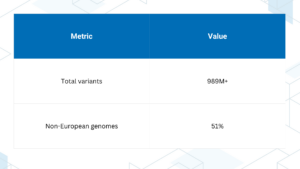
By bringing together 515,579 reference genomes and broad ancestry representation, the All of Us + AnVIL reference panel helps researchers expand lower-cost array data into richer genomic datasets for population genomics, translational research, and precision medicine studies.
Other highlights include:
Scientific validation
Broad Clinical Labs performed preliminary validation studies using Global Diversity Array (GDA) data from 42 ancestrally diverse participants with matched 30X whole genome sequencing (WGS) data generated at the Broad Institute.
Imputation results from the All of Us + AnVIL Imputation Service were validated directly against the 30X WGS baseline. In preliminary analyses, the service demonstrated high imputation confidence (R²) across a wide range of allele frequencies and ancestry groups, showing notable strengths in SNP and indel imputation within several non-European populations.
These findings underscore the importance of ancestry representation in reference panel design and imputation performance.
From array data to analysis-ready results
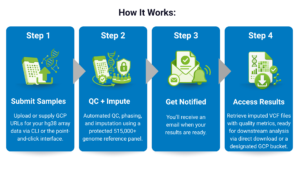
The service is designed to simplify genotype imputation for research teams by bringing sample submission, quality control, phasing, imputation, notification, and result delivery into a single workflow.
Researchers can submit hg38 array data and receive analysis-ready outputs without managing local infrastructure, pipelines, or reference panels.
Built for research teams working at scale
The All of Us + AnVIL Imputation Service is designed for teams generating or analyzing array-based genomic data across population-scale and translational research programs.
The service may be especially useful for researchers working on:
- GWAS, meta-analyses, and cohort harmonization
- Polygenic risk score discovery, validation, and portability
- Large-scale biobank and cohort studies
- Clinical trial, biomarker discovery, and translational research workflows
- Projects that need secure and managed workflows for QC, phasing, imputation, and result delivery
Learn more
Ready to test the All of Us + AnVIL Imputation Service with your own array data?
The first 2,500 samples submitted through the service are currently available at no cost, giving research teams a practical way to evaluate performance, assess fit, and bring imputation into existing genomic workflows.
Contact us to discuss your project, ask questions, or get started with your first submission.
Service portal: https://allofus-anvil-imputation.terra.bio/
Help center: https://broadscientificservices.zendesk.com/hc/en-us/
This work was made possible through NIH-supported programs including the All of Us Research Program and NHGRI AnVIL.